Healing Through Connection in Hoima
By Barbara Kemigisha & Etheldreda Nakimli Mpungu
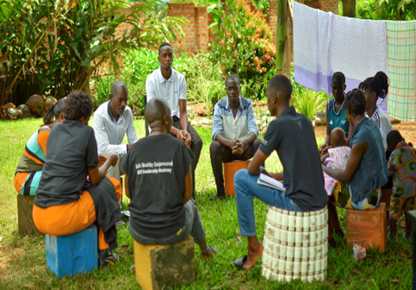
In Hoima, Barbara, one of our team members, noticed something that did not sit right with her. Health centers were organizing support groups for people living with Human immunodeficiency virus (HIV). They offered transport allowances and refreshments, yet the rooms stayed half-empty. Almost no one came or spoke. The sessions felt forced, like ticking a box rather than touching lives.
Barbara, who herself lives with HIV, decided to try something different. Through her foundation, she invited all young people, not just those living with HIV, to meet once a week. No transport allowance, no labels, no segregation. Just a space to talk, laugh, and learn from one another. To everyone’s surprise, they came. They continued to come, week after week. They shared stories, supported one another, and even started small savings groups and livelihood projects. What began as a simple idea grew into a community built on trust, belonging, and hope. From this experience, she realized a simple truth: “Young people don’t want to be labored patients. They want to be participants in life.”
The Lesson
What kept them coming was not money or medical training, but emotional and social connection. They discovered that belonging, rather than treatment, provided recovery.
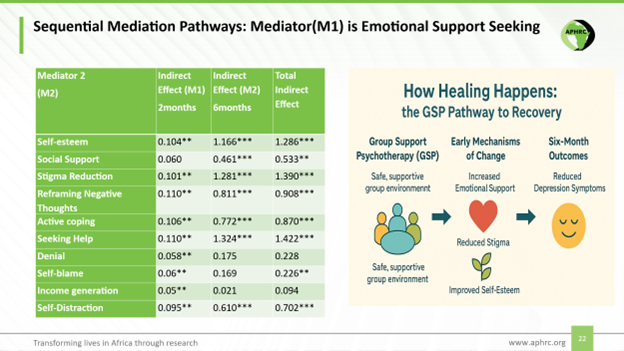
This real-world experience reinforces what our Group Support Psychotherapy (GSP) research demonstrates scientifically: Increased emotional support, reduced stigma, and strengthened self-esteem are early mediators of GSP recovery. Healing starts when people feel valued, connected, and capable again.
Making data accessible to communities
This lived experience from Hoima perfectly mirrors our quantitative findings: Our mediation analyses confirm that: Emotional social support is the earliest and strongest mechanism through which GSP reduces depression. Reduced stigma and enhanced self-worth are key pathways sustaining recovery over time.
The same forces that made the Hoima youth group thrive, belonging, shared experience, and social acceptance, are the very mechanisms that make GSP effective.
Bringing it all together
The Hoima experience shows us that when young people meet as peers, not patients, healing starts naturally. Our data shows that increased emotional and social support and stigma reduction are the engines of that healing. Together, they point to a clear opportunity: to integrate GSP’s proven therapeutic skills into existing youth groups, community clubs, and peer networks, where these natural mechanisms are already at work. This approach aligns directly with the goals of the Mental Health Data Prize Africa, which seeks innovative, data-driven solutions to improve mental health across the continent. By combining lived experience with rigorous analysis, initiatives like this demonstrate how evidence-informed, community-led interventions can be scaled sustainably, inclusively, and in ways that truly empower young people.